
New Mexico Clerk Structure
New Mexico uses a functional split between judicial court clerks and elected County Clerks. The split is real, but it does not mean every county has a Texas-style independently elected District Clerk. District, Magistrate, Metropolitan, Municipal, Probate, and appellate records remain with the clerk or office responsible for the court where the matter was filed. The County Clerk is a county-government officer and records county documents rather than judicial case files.
The record itself identifies the correct side. A felony judgment, divorce decree, civil complaint, or Magistrate Court docket belongs to a court clerk. A deed, mortgage, marriage license, county ordinance, resolution, or election record belongs to the elected County Clerk. County Probate Court presents a local overlap: the County Clerk may support the probate judge in informal proceedings, but the probate court is still the office to contact for an informal estate file. Formal or contested probate belongs to District Court.
New Mexico Court Clerks
A New Mexico court clerk accepts filings, assigns or maintains case identifiers, updates the docket, safeguards the official court record, collects authorized fees, and issues copies or certifications. The correct clerk follows the court level. District Court clerks hold felony, major civil, divorce, family, children's-court, and contested probate files. Magistrate and Metropolitan clerks hold records within those limited courts. Municipal clerks maintain city-court cases, while appellate clerks maintain Supreme Court and Court of Appeals dockets.
- Complaints, petitions, answers, motions, and filed exhibits
- Criminal charging papers, pleas, judgments, and sentences
- Divorce petitions, family orders, and final decrees
- Dockets, hearing entries, court orders, and appellate filings
- Certified copies of documents in the court's own case file
Case Lookup provides public electronic case data, not document images. re:SearchNM supplies role-based registered access to some case information and documents. If neither channel provides the needed item, inspect it at the court clerk's office or submit a New Mexico Courts records request.
New Mexico County Clerks
Each New Mexico county elects a County Clerk. That office records and preserves county public records rather than serving as the general clerk of trial court. The captured Cibola County materials provide a representative example: the County Clerk keeps resolutions, ordinances, deeds, mortgages, and marriage licenses, administers elections, and supports the probate judge's office. The same source warns that the clerk records documents but cannot provide legal advice about drafting or legal effect.
- Marriage licenses issued and recorded by that county
- Deeds, mortgages, and other recorded property instruments
- County resolutions, ordinances, and designated public records
- Election administration records and public request forms
Do not send court pleadings, criminal judgments, divorce decrees, or ordinary case-document requests to the County Clerk. Likewise, New Mexico Courts states that its court records office does not maintain marriage licenses, motor vehicle driving records, law-enforcement records, or public criminal background checks. Matching the record to the custodian prevents delay.
New Mexico Court Clerk vs County Clerk
The distinction turns on whether the item was filed in a judicial case or recorded as a county document. County Probate Court is the main point where local support can overlap, so ask the probate office directly for an estate file.
| Record / Case Type | Court Clerk | County Clerk |
|---|---|---|
| Felony criminal cases | District Court clerk | No |
| Misdemeanor and traffic cases | Clerk of filing Magistrate, Metropolitan, or Municipal Court | No |
| Civil cases | Clerk of the filing court | No |
| Family, divorce, and custody | District Court clerk | No |
| Informal uncontested probate | County Probate Court office | May support the probate judge locally |
| Formal or contested probate | District Court clerk | No |
| Marriage licenses | No | Yes, issuing county |
| Deeds and mortgages | No | Yes, recording county |
New Mexico Court Clerk Duties
Court clerks preserve the official judicial file and provide access allowed by court policy and law. They receive case papers, maintain docket entries, process court-issued documents, collect authorized charges, and certify copies. They do not perform a public criminal background check, hold police reports, or replace legal counsel. A clerk can identify what is filed and explain access procedure, but cannot tell a requester what claim to bring or draft a pleading.
- Accept filings and associate them with the correct case
- Maintain the official file, docket, and court orders
- Process summonses, writs, and other authorized court papers
- Collect filing, copy, certification, and case payment amounts
- Provide inspection and issue plain or certified copies
- Support approved electronic filing and records systems
New Mexico's Inspection of Public Records Act generally protects inspection rights unless a specific exception applies. Court access also follows Supreme Court online-access policy. Sealed files, confidential cases, and protected personal identifiers are not released through ordinary public channels.
Request New Mexico Certified Copies
A certified copy bears the custodian's authentication of a filed record. Ask for certification when the receiving agency, court, title company, or other institution requires it. A public Case Lookup printout is not a certified document. First decide whether the record is judicial or county-recorded, then locate the exact court or county that holds it.
- Identify the filing court for case records or the recording County Clerk for county documents.
- Gather the case number, party names, filing year, and exact document title if known.
- Contact the custodian to confirm access, certification fee, payment, and delivery method.
- Submit the written or online request with enough detail to locate the record.
- Review the delivered copy for the clerk's certification and the requested pages.
New Mexico Court Request Fields
The New Mexico Courts IPRA webform asks the requester to select a court location and responsible department before describing the record. It is a request route, not an instant search. The court may need enough subject data to distinguish people with similar names.
| Field | Required | Notes |
|---|---|---|
| Court location and department | Yes | Select the judicial district, appellate court, Metropolitan Court, or AOC as applicable. |
| Requester name and contact details | Yes | Email, phone, and mailing address are requested. |
| Subject name and alias | Yes | First name, last name, and alias help identify the record. |
| Birthdate | Optional | May distinguish people with similar names. |
| Record type | Yes | Civil, family, criminal, other case documents, or other. |
| Case number | Requested | Use the full number when known. |
| Records description | Practically required | Describe documents with reasonable particularity. |
New Mexico Clerk Fees
The research did not establish one statewide schedule that applies to every court and County Clerk service. County sources may charge reasonable copy fees and postage in advance. Confirm the current amount before mailing payment. Cibola Probate Court supplies a useful county-specific example, while other county and judicial offices may differ.
| Item | Amount |
|---|---|
| County Clerk copies | Reasonable fees; confirm locally |
| Postage | May be required in advance |
| Cibola informal probate docket | $30.00, representative only |
| Cibola probate certification | $1.00 per filed document, representative only |
| Cibola probate filed copies | $0.50 per page, representative only |
| Other court filing or certification | Confirm with the filing court |
New Mexico Clerk Forms
Forms differ by agency and function. The statewide court request form covers judicial records. County document centers may offer IPRA, recording, business-registration, and voter-information forms. Probate courts may publish will, no-will, notice, inventory, accounting, closing, poverty, special-administrator, and District Court transfer forms. Always use the current form from the office that will receive it.
- New Mexico Courts IPRA request for judicial case documents
- New Mexico divorce self-help forms for District Court filing preparation
- Cibola County Clerk document center as a representative local form library
New Mexico Electronic Filing
Odyssey File & Serve is New Mexico's account-based electronic filing channel. It is not a public court-record search. Public case data belongs in Case Lookup, and document access depends on re:SearchNM registration and access tier. County-recording systems are separate. For example, Cibola County reports CSC eRecording for documents recorded with the County Clerk, while that service does not search marriages or judicial cases.
The official Odyssey File & Serve portal requires an account.
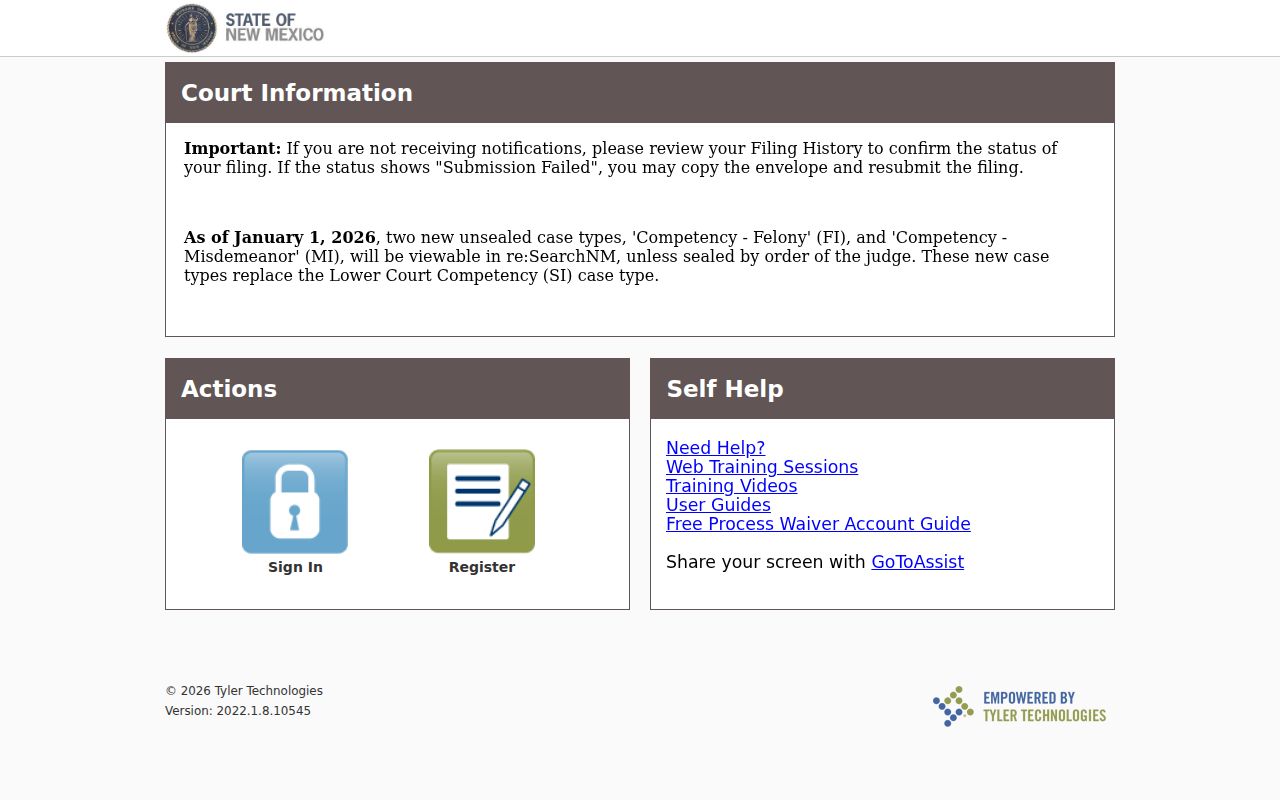
The account screen reinforces the boundary between filing a document and looking up a public court record.
Mail remains an office-specific channel. Confirm the precise court or County Clerk, accepted payment, number of copies, and need for a self-addressed envelope. A representative Cibola County Clerk instruction sends recorded documents to its own mailing address with a return envelope, but other counties may publish different rules.
Find New Mexico Clerks by County
Every New Mexico county has an elected County Clerk, and judicial records are maintained by the clerk of the court where each case was filed. Browse the directory of all 33 New Mexico counties to reach local office details. Before sending a request, label it by record type: court case document, marriage license, deed, county public record, election item, or probate file. That first classification determines the correct custodian and access method.
For an older file, confirm whether a county-boundary change affected custody. Cibola County's 1981 creation from part of Valencia County means a pre-creation record may require checking the earlier jurisdiction. This is a practical inference from official county history, not a guarantee that every older record moved or remained in one place. Ask both likely custodians when the filing date predates the present county.