
Search New Mexico Court Records
Start with New Mexico Case Lookup. It offers free individual electronic case searches without registration after the user accepts its data-use notice. Public data covers the appellate courts, District Courts, Magistrate Courts, the Bernalillo County Metropolitan Court, and limited Municipal Court records. It can identify a case and show its status, but it does not deliver filed documents. Municipal coverage is limited, and records from before 1997 require a request. The filing court remains the custodian of the official New Mexico court record.
Collect the party's full name, birth year if known, court type, filing county, and case number. Name-only searches can return several people. A full case number is stronger because it combines court type, court location, case category, and the numeric identifier. When the county is unknown, narrow the search by court type and date. When online data is missing, use the court finder and contact the clerk in the county where the matter began.
- Open Case Lookup, read the limits, and select “I Accept.”
- Search by party name, complete case number, or the separate DWI historic-conviction form.
- Confirm the court, location, case category, party, and filing date before treating a result as a match.
- Use re:SearchNM access guidance for eligible registered document access.
- Request copies from the filing court in person, by mail, or through the New Mexico Courts IPRA form.
The official Case Lookup source shows the public entry point used statewide.
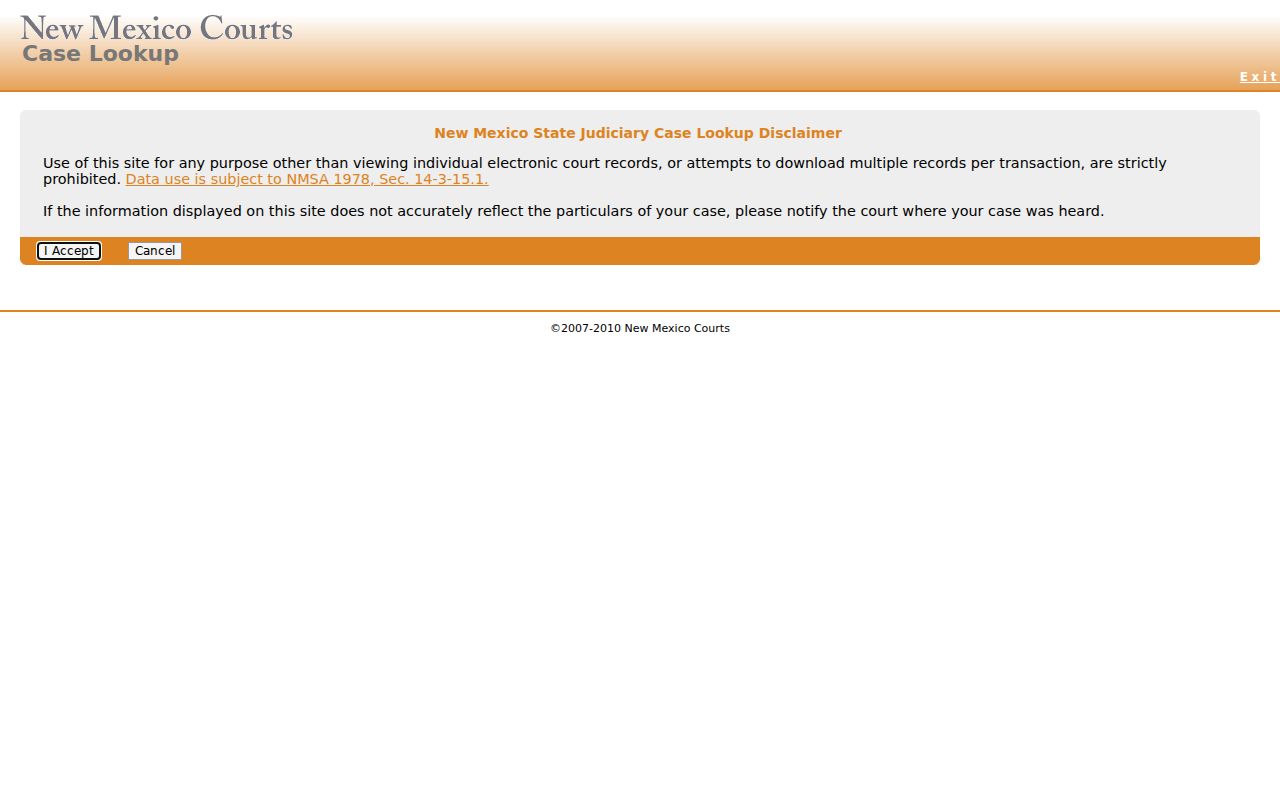
The captured screen confirms that access begins with a disclaimer, which matters because the database is for individual searches and not bulk extraction.
New Mexico Court Record Fields
The statewide name form supports broad and focused searches. Court type codes distinguish District, Magistrate, Metropolitan, and Municipal Courts. Location choices then change with that selection. Date filters can use filing or hearing dates. The most useful fields are shown below; all should be treated as search aids rather than proof of identity.
| Field Label | Type | Required | Notes / Format |
|---|---|---|---|
| Name | Text | Unspecified | Up to 35 characters; format is last, first, middle. |
| Driver License and State | Text and dropdown | No | Optional identifying details for a name search. |
| Date of Birth | Date or year | No | Full date uses MM/DD/YYYY; year-only search is available. |
| Court Type | Dropdown | No | D, M, T, or U for District, Magistrate, Metropolitan, or Municipal. |
| Court Location | Dropdown | No | Options depend on the selected court type. |
| Case Category | Text | No | Two-character category code. |
| Date Type and Range | Radio and date fields | No | Filter by filing date or hearing date. |
| Results | Dropdown | No | Controls the number of displayed matches. |
Types of New Mexico Court Records
New Mexico assigns records by subject and court jurisdiction. District Courts keep major civil actions, felonies, family and divorce matters, children's cases, and formal or contested probate. Magistrate Courts handle limited civil disputes, landlord-tenant cases, misdemeanors, DWI, traffic, and felony preliminary proceedings outside Bernalillo County. The Metropolitan Court performs much of that work in Bernalillo County. Municipal Courts keep ordinance, petty-misdemeanor, DWI, and traffic cases arising within a city. County Probate Courts keep informal, uncontested estate matters.
The elected County Clerk is a different office. It records deeds, mortgages, marriage licenses, county ordinances, and election material, not judicial pleadings or criminal judgments. A request for a divorce decree, felony judgment, or court docket therefore goes to the court clerk. A marriage license or recorded deed goes to the County Clerk. That split prevents many failed New Mexico court records requests.
- Civil files may contain complaints, answers, motions, orders, judgments, and settlement documents.
- Criminal files may contain complaints, charges, pleas, bond orders, dispositions, judgments, and sentences.
- Family files may contain petitions, decrees, support worksheets, custody orders, and hearing records.
- Probate files may contain wills, applications, appointments, notices, inventories, and closing papers.
- Traffic files may contain citations, pleas, hearing dates, fines, and failure-to-appear entries.
What New Mexico Court Records Show
An electronic result is an index to the case, not the complete file. It may show court and location, case number, category, parties, filing and hearing dates, case style, docket events, financial obligations, status, and disposition. A docket entry records that something happened or was filed. It does not always reveal the document's text. Registered re:SearchNM access or a clerk request may be needed to inspect the item itself.
| Field | What It Shows |
|---|---|
| Case Number | Combines court type, location, category, and a numeric identifier. |
| Filing Date | Shows when the clerk opened the action. |
| Parties | Identifies plaintiff and defendant, petitioner and respondent, or criminal defendant. |
| Docket Entries | Lists filings, settings, orders, continuances, judgments, and other actions in date order. |
| Hearing Date | Shows a scheduled appearance; confirm changes with the court. |
| Financial Data | May show fines, fees, bond, costs, or payment duties when public. |
| Disposition | Reports dismissal, conviction, judgment, sentence, or closed status when entered. |
| Documents | Not supplied by public Case Lookup; use authorized access or request them from the clerk. |
The Odyssey Public Access landing page is another official doorway to New Mexico court access services.
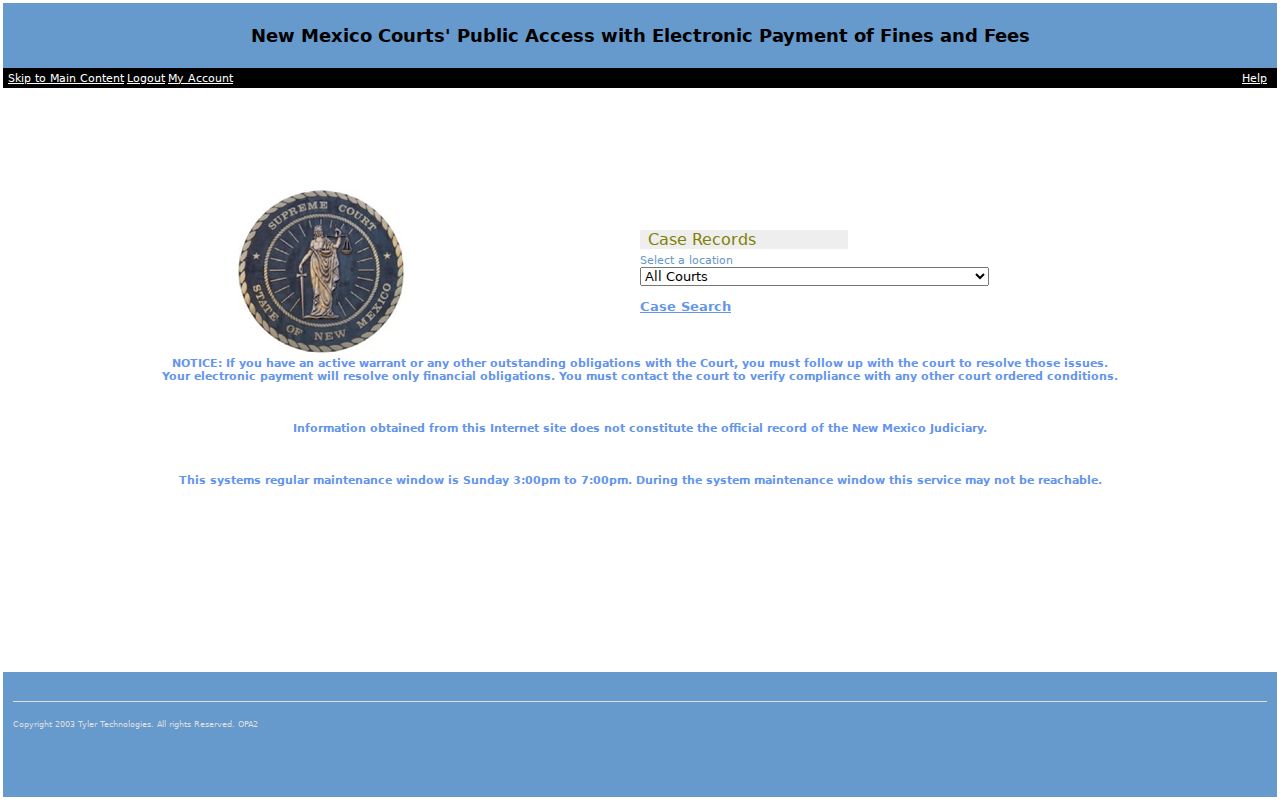
Its separate landing screen reinforces the difference between public case information and role-based access to filed court documents.
New Mexico Court Record Access
NMSA 1978, Section 14-2-1 states the general right to inspect public records unless a specific exception applies. Written court-record requests must identify the requester and describe the desired records with reasonable particularity. Online access is narrower. The New Mexico Case Access Policy uses access tiers and does not make every document available to every user.
Case Lookup also restricts bulk use under NMSA 1978, Section 14-3-15.1. For a copy, contact the filing court and ask about inspection, ordinary copies, certification, mailing, and current payment rules before sending funds. The research did not establish one uniform statewide court-copy price, so local confirmation is essential. The Administrative Office of the Courts is not the custodian of each case file.
Note: Public inspection does not mean every New Mexico court document is available online or free from lawful redaction.
Restricted New Mexico Court Records
Public Case Lookup omits Social Security numbers and address information. Juvenile criminal cases have not been displayed there since July 1, 2007, and Family Violence Protection Act order-of-protection cases have not been displayed since July 1, 2008. Adoption, abuse or neglect, FINS, and mental-health matters also receive restricted access under the online policy. Sealed and expunged records do not appear through ordinary public channels.
New Mexico's Criminal Records Expungement Act permits qualifying people to petition for expungement of certain arrest and public criminal records. Eligibility, waiting periods, completed-sentence rules, and unpaid obligations can affect the result. Expungement limits public release but does not destroy the record, and some criminal-justice or regulated uses remain. Tribal and federal records cannot be expunged under the state act. A requester seeking a restricted record must use the court's lawful access process rather than assume a missing online result means no case exists.
Find New Mexico Court Records Offices
New Mexico has 33 counties, but court custody follows the filing court rather than a single statewide records warehouse. Use the county directory to reach the local court site, then identify District, Magistrate, Metropolitan, Municipal, or Probate Court. The court and county clerk overview explains why judicial files belong with court clerks while land, marriage, election, and county-government records belong with elected County Clerks. For an older case, a certified copy, or a document absent online, contact the filing court before submitting the state court IPRA form.
Tip: Match the county, court level, and case type before sending a New Mexico court records request or payment.
The New Mexico Courts request form asks for the judicial district or statewide court, the specific court or department, requester name, email, phone, mailing address, and identifying facts about the record subject. It also requests a record category, case number when known, and a description of the desired documents. Civil, family, criminal, and other case documents are separate choices. A precise request should name the pleading, order, judgment, or date range rather than ask for every possible item tied to a broad name.
County Clerk records follow a separate New Mexico IPRA path. The Cibola County transparency process is a representative local example: oral or written requests are accepted, but formal IPRA procedures apply to written requests. That office asks for contact information and enough detail to locate the county-held record. It does not become the custodian of District or Magistrate Court case files merely because both offices serve the same county.
Certification should be requested only from the custodian that holds the original. A screenshot or Case Lookup printout can help locate a New Mexico court record, but it is not a clerk-certified judgment or decree. Before mailing a request, confirm the copy format, certification need, page range, current charge, accepted payment, and return method. If the case moved on appeal, trial-court and appellate records may be held by different clerks. Ask for the precise item needed rather than a broad duplicate of the whole file.
Keep the clerk's receipt with any certified copy.