
New Mexico Criminal Court Records
The criminal case file begins when a complaint, information, or indictment is filed. It differs from the law-enforcement arrest record and from a jail booking profile. The judicial file records the formal charges, defense appearances, bond orders, settings, motions, pleas, findings, sentence, and later court action. The New Mexico arrest and charge record explains the earlier arrest-to-charging path, while this file follows the prosecution through its outcome.
District Courts have general jurisdiction and keep felony records after charging and preliminary stages. Magistrate Courts handle misdemeanors, DWI, traffic, and felony preliminary proceedings outside Bernalillo County. The Bernalillo County Metropolitan Court performs much of that limited-jurisdiction work there. Municipal Courts hear city ordinance, petty misdemeanor, DWI, and traffic matters without jury trials. The relevant court clerk, not the elected County Clerk, keeps the criminal case file.
Search New Mexico Criminal Records
New Mexico Case Lookup gives the general public free, no-registration access to individual electronic cases after acceptance of its disclaimer. It covers appellate, District, Magistrate, Metropolitan, and limited Municipal Court data. Search by defendant name, full case number, or the separate DWI historic-conviction option. Public results are case data, not filed document images. Records before 1997 require the request route.
- Choose a name search, case-number search, or DWI search.
- Use date of birth, court type, location, category, and date filters when available.
- Confirm the defendant, case number, filing court, and filing date.
- Read each charge and docket event through disposition and sentence.
- Use re:SearchNM or request the needed document from the court clerk.
Missing data may reflect limited Municipal Court coverage, an older record, a confidential case, or the wrong court location. Juvenile criminal cases have not appeared publicly since July 1, 2007. For source documents, consult re:SearchNM access rules or submit the New Mexico Courts IPRA form. The county directory routes requests to the filing county.
New Mexico Criminal Case Stages
Each stage leaves a different docket footprint. A filed accusation starts the court record. Arraignment addresses charges, rights, counsel, and a plea. Pretrial entries can include discovery disputes, suppression motions, bond review, continuances, and scheduling orders. The case then ends through dismissal, plea, acquittal, or conviction. If guilt is established, sentencing records the punishment, supervision, restitution, fines, and other terms.
Case flow: Charges Filed › Arraignment › Pretrial / Motions › Plea or Trial › Disposition › Sentencing
- Arraignment
- The court states the accusation, addresses rights and counsel, and may receive a plea.
- Pretrial and motions
- The parties litigate legal issues, exchange information, and prepare for resolution.
- Plea or trial
- The defendant may enter a negotiated plea or require the state to prove the case at trial.
- Disposition
- The record states dismissal, acquittal, conviction, or another final result for each charge.
- Sentencing
- The judge imposes custody, probation, fines, restitution, or other lawful terms after conviction.
What New Mexico Criminal Records Show
Electronic fields summarize the case and point to the official file. Exact labels vary by court. Case Lookup can show docket activity and status, but it omits the filed PDFs. It also withholds Social Security numbers and address information. Read charge-level dispositions carefully because one case may contain several accusations with different outcomes.
| Field | What It Shows |
|---|---|
| Case Number | Court type, location, case category, and unique numeric identifier. |
| Defendant | Name of the person formally accused in the case. |
| Charges | Filed allegations, which may later be amended, reduced, dismissed, or resolved. |
| Plea | The defendant's formal answer to a charge. |
| Docket | Chronological list of filings, hearings, orders, and court actions. |
| Disposition | Outcome for the case or each charge. |
| Sentence | Punishment and conditions imposed after conviction. |
Charges vs. Convictions
A charge is an accusation, not a finding of guilt. New Mexico criminal court records may retain charges that were amended, dropped, dismissed, or resolved by acquittal unless access is later restricted by law. A conviction arises only from a guilty plea or finding. Read the disposition tied to each count rather than assuming the arrest label or first complaint states the final outcome.
| Charge | Conviction | |
|---|---|---|
| Stage | Accusation | Verdict or plea |
| Burden of Proof | Probable cause | Beyond reasonable doubt |
| Public Record | Yes | Yes |
Reading Dispositions and Sentences
“Dismissed” means the court ended the charge without a conviction. Dismissal with prejudice generally bars refiling, while dismissal without prejudice may permit it. “Not guilty” reflects an acquittal; “guilty” reflects a plea or finding. The research did not confirm a statewide published code list, so unexplained abbreviations should be checked with the clerk. Sentence entries should be read with later modifications, probation orders, payment records, and appellate action.
Sealed vs. Expunged Records
New Mexico sealing restricts access under a court order or confidentiality rule. Expungement under the Criminal Records Expungement Act can limit public release of eligible arrest and criminal records after a successful petition. The records are not destroyed. They remain available for future criminal proceedings and certain regulated uses. Eligibility depends on the case, completion of sentence, payment of obligations, statutory waiting rules, and exclusions. Tribal and federal records cannot be expunged under the state act.
| Sealed | Expunged | |
|---|---|---|
| Visibility | Restricted by law or court order | Public release limited after a granted petition |
| Record Status | Still exists | Still exists; New Mexico does not treat it as destroyed |
| Eligibility | Depends on governing confidentiality rule | Depends on the Criminal Records Expungement Act |
New Mexico Criminal Record Access
New Mexico's Inspection of Public Records Act establishes a general right to inspect public records unless an exception applies. Court access also follows the Supreme Court's online case access policy. Public access does not override juvenile confidentiality, expungement, sealing, protected case types, or redaction of personal identifiers. The filing court is the custodian of the case file, while statewide Case Lookup is an index for individual electronic searches.
Key Statutes:
NMSA 1978, Section 14-2-1 establishes the general public right of inspection subject to exceptions.
Criminal Records Expungement Act permits qualifying petitions to limit public release of certain records.
Background Check Considerations
A statewide criminal-history repository is not the same as a court case file. The New Mexico DPS Law Enforcement Records Bureau is the state-level criminal-record agency, while the filing court supplies the docket and source documents for one prosecution. New Mexico Courts expressly says its IPRA office does not conduct background checks or keep law-enforcement records. Formal employment, housing, credit, or insurance screening must comply with the Fair Credit Reporting Act and other applicable law.
The official DPS page presents the Law Enforcement Records Bureau and related statewide record functions.
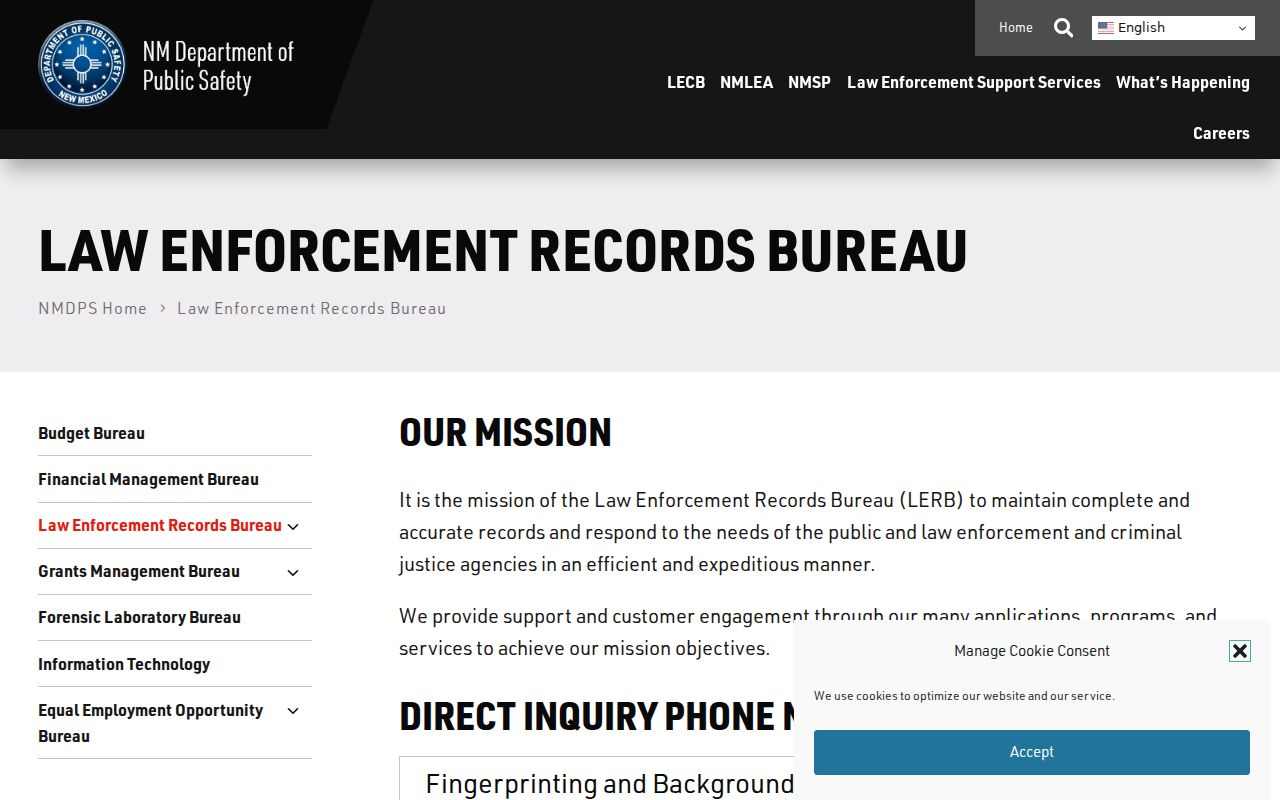
This statewide source should be distinguished from Case Lookup, which tracks individual judicial cases rather than compiling a law-enforcement history.
Important: These New Mexico criminal records cannot be used here for employment, credit, housing, insurance, or other FCRA-regulated decisions.
Restricted New Mexico Criminal Records
Juvenile criminal cases have not been displayed in Case Lookup since July 1, 2007. Sealed and expunged cases are excluded from ordinary public access, and Social Security numbers and addresses are withheld. Adoption, abuse or neglect, FINS, and mental-health records also receive heightened protection. A missing result may reflect confidentiality rather than the absence of a case. Requesters must use the filing court's lawful access process and cannot bypass a restriction through re:SearchNM or IPRA.
Defense files are not public court databases. New Mexico Law Offices of the Public Defender locations help defendants find the correct office, while people in counties without an office may receive appointed contract counsel through the court. The official office image below illustrates the statewide defense network, not a source for searching another person's privileged lawyer file.

The directory supports procedural contact after appointment, while the public criminal court record remains with the court clerk.
New Mexico defense procedure also explains some docket entries. A jailed defendant with an appointed public defender is assigned counsel through the court, and counsel arranges a meeting when possible. A person who is not jailed applies through the closest LOPD office. The official instructions documented a $10 cash or money-order application cost plus proof of income and government assistance when applicable. In a county without an LOPD office, the court appoints counsel and should provide contact information.
The LOPD application instructions show this public procedure.

An attorney's appearance may be public on a docket, but the lawyer's privileged case file is not a public criminal-record search source.
Likewise, a district attorney's role is to decide how referred allegations proceed. A booking label can differ from the complaint, information, indictment, amended count, or final disposition. Victim notification can also use channels outside the public docket. New Mexico SAVIN or VINE may provide automated notices, while written notice in violent-crime matters can require direct registration with the prosecuting office. Those services supplement the court record and do not replace it.
For accuracy, compare the latest docket event with the judgment and sentence. A financial entry may show fines, fees, restitution, bond, or court costs, but it may not state whether every obligation is current. Probation is court-ordered supervision, while parole is post-prison supervision under corrections authority. Custody status can also change after sentencing. Those later systems should not be inferred from an old New Mexico criminal court record alone.